Page 2 is taking a break tomorrow and Friday. We’ll be back on Monday.
The Mat-Su Salmon Symposium was last week in Palmer. Wilson Justin opened the symposium with a welcome. He is an Ahtna Dene culture bearer.
Justin reminded us that in Dene culture everything is tied to place and a time. People gathered the last of the salmon at the Matanuska River on the walk home. They sang. They left gifts for the river. Leaving was a kind of welcome: we leave, we give, we take, and we will always be part of your time and place.
Upper Cook Inlet Chinook populations and Little Su River coho salmon are considered a stock of concern. Fish and Game has counted fewer big, older Chinook and more young, small male salmon at their fish weir on the Deshka River.
Salmon face multiple pressures.
Heat may be part of the reason for fewer fish. Warmer waters make it harder for salmon to migrate and reproduce.
The warmer waters also help pike. Young pike quickly grow big enough to eat juvenile Chinook.
Salmon can cope with heat if they get some cold-water time. They may have to run a gauntlet of hungry pike to reach cold-water springs.
Strategies to reduce pike include treating lakes with rotenone and building pike fences to keep them from coming back. Pike can’t jump more than about fifteen inches. Salmon can. The Kenai Peninsula Borough has lakes that are now pike-free due to these treatments.
The Deshka is one of the few weirs that operate every summer. That means salmon management is based on few data points.
Dr. Will Atlas of the Wild Salmon Center recognizes the need for more data. He says it is up to us to build the tools we need. He is working with the Sitka Tribe and First Nations on AI tools that count salmon on video and sonar. Drones can add habitat information such as landslides. Tools can be built out into remote areas.
We don’t even know where the salmon are. Ben Meyer of the Kenai Watershed Forum says we may have mapped half of the habitat in the Mat-Su. He is creating maps that predict the upper extent of salmon.
Kenai models might help identify Mat-Su streams to target. The Tyonek Tribal Conservation District mapped more than fifty miles of new salmon habitat this year by foot and helicopter.
Atlas described his interest in developing a pattern-recognition tool to identify and sort pike from salmon. In a serendipitous connection, the Tyonek Tribal Conservation District just won funding to address this issue.
Science is only as effective as the policy it drives. Recent policies are getting more salmon through Cook Inlet and up to the Mat-Su. The Board of Fish shifted commercial fishing closer to shore. This leaves a corridor for migrating fish. Federal waters closed to fishing when a coho cap was reached.
But what will salmon find when they reach Mat-Su streams? Robert Howard of the Knik River Watershed Group showed habitat torn up by ATV ruts. He noted that management-plan wording has weakened over time, from motorized vehicle access “only on winter ice” to access that “should be” on ice.
The Deshka’s springs have been mapped with thermal imagery. However, the Borough has not adopted a land classification that would flag the Borough lands with springs as special.
Policy is driven by community. Amy Bushatz of the Mat-Su Sentinel offered a rule in storytelling: make it local and relevant. An audience member says he connected with presentations about places he knew. For instance. Fish and Game confirmed that a drop in water level at Neklason Lake happened when a culvert was replaced.
First-time attendee Will Ashton pointed to the passion in the room, to the variety of talks, to the value of stewardship and citizen science, and using a workshop as a break from slides. He suggested evening sessions would be more available to working people.
Kevin Toothacre of the Knik Tribe brought us back to a time when the salmon were plentiful. He used archaeological knowledge of food storage sites and longhouses and AI to provide an aerial view of small camps of people up and down the Deshka River. Like Justin’s welcome address, the idyllic scene lingered. People connected to salmon and place.
Recordings of the sessions will be posted at matsusalmon.org.
Kendra Zamzow reported this Page Two article and yours truly, Lee Henrikson produced it.
If you have an idea for a Page 2 topic, please email us at page2@radiofreepalmer.org.
Page 2 airs weekdays at 7 a.m., 9 a.m., 11:50 a.m., and 6 p.m.
Tune in at 89.7 in Palmer, 89.5 in Sutton, 88.3 in Chickaloon and Glacier View or online at bigcabbageradio.org.
Please support Page 2 News and Big Cabbage Radio. Become a member: Donate today at bigcabbageradio.org.
That’s it for today and the news on Page Two on Wednesday, Nov. 25, 2026.
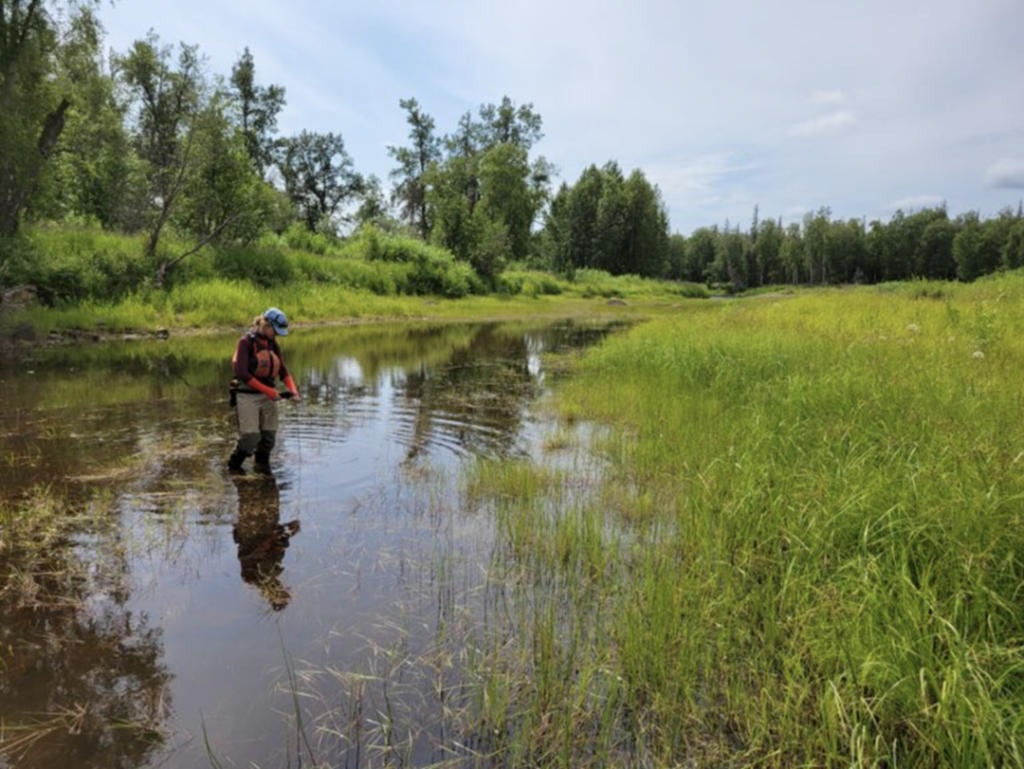
Photo credit: The Deshka River by Cook InletKeeper