
You find a bird on the ground. Maybe it hit a window. Maybe a wing is hanging wrong. What do you do?
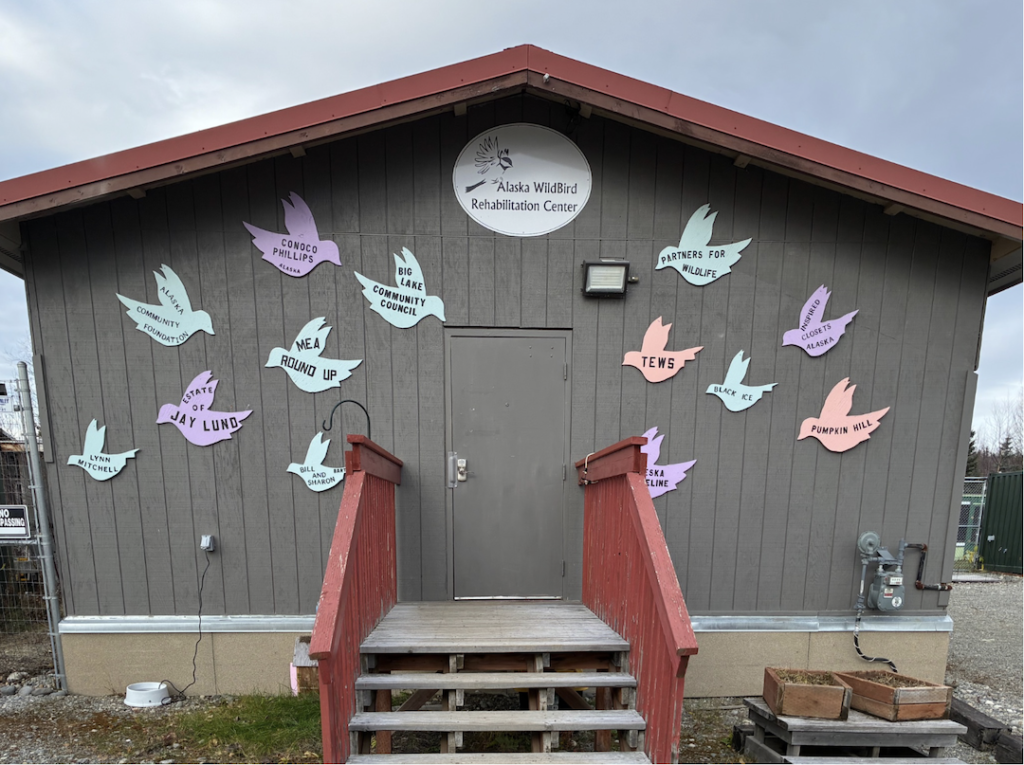
In the Mat-Su Valley the answer starts with a phone call. The Alaska WildBird Rehabilitation Center near Houston takes in about 200 injured birds a year. The birds range from songbirds to bald eagles. It’s the only bird rehab center north of Anchorage.
Executive Director Shannon Jensen says finding a hurt bird can make people feel helpless. That’s where the center comes in.
Jensen says, “We answer the phone. We can educate them and help them out.”
Many of the injuries are caused by humans – even if not on purpose. A bird hits a window. A cat sneaks out.
Jensen says window pane treatments such as decals or screens help prevent window collisions. The treatments improve visibility for birds.
Hunting is part of the DNA in cats and dogs. The owner has a duty to prevent pets from wandering outside. Jensen says the best fix is keeping pets close to home. She advises owners to give cats things to do inside such as toys or climbing spots.
Tips on protecting birds from injuries will be posted on akwildbird.org soon.
The center relies on the community to locate injured birds.
Here are the three steps to follow if you find a bird that appears injured or is known to be orphaned.
Step one is keep your distance. Jensen explains that the birds don’t want to be petted. All they need is good care.
Step two, take a picture or video of the bird and take note of the map location.
Step three, call the Alaska WildBird Rehabilitation Center at 907-892-2927. The hotline is answered 24 hours a day.
A volunteer will talk you through the intake process. They will ask you to bring the bird to a specified meeting place, or they will come to you to collect it.
Jensen says it’s one-on-one education.
Once a bird is brought to the center, a volunteer veterinary technician assesses it. Physical therapy is necessary in many cases. This can be things like flexing a wing joint or manually pedaling a bird’s feet.
Jensen says a bird must recover all its strength and endurance before it can be released. It’s as if it was an elite athlete.
The goal of the center is to release the birds back to the wild. The bird is on its own for survival after release. Jensen explains that although the work isn’t glamorous, it makes a difference.
The center began in a private home about 20 years ago. It has grown into one of four rehab facilities statewide. It’s located on 25 acres in a refurbished school portable. Jensen is the one paid employee.
Jensen says that she wouldn’t be able to do it without volunteers. There are about 30 volunteers maintaining the center.
These include positions such as veterinary technician, educator, special events coordinator, fundraising coordinator, and more.
The center depends on grants, online auctions, donors, and fundraisers.
The center is holding a gun raffle for a rifle or a handgun. Tickets are $20 each. The drawing is on December 1.
To buy a raffle ticket, volunteer, donate, or learn more go to akwildbird.org.
And if you find an injured bird, call the center’s 24-hour hotline at 907-892-2927 and the website is akwildbird.org.
Jamie Lundgren reported this Page Two article. Lundgren is a senior at Career and Technical High School. And yours truly, Lee Henrikson produced it. If you have an idea for a Page 2 topic, please email us at page2@radiofreepalmer.org.
Page 2 airs weekdays at 7 a.m., 9 a.m., 11:50 a.m., and 6 p.m.
Tune in at 89.7 in Palmer, 89.5 in Sutton, 88.3 in Chickaloon and Glacier View or online at bigcabbageradio.org.
Please support Page 2 News and Big Cabbage Radio. Become a member: Donate today at bigcabbageradio.org.
That’s it for today and the news on Page Two on Wednesday November. 18, 2026.
Photo: The Alaska WildBird Rehabilitation Center by Jamie Lundgren