
Can you overwinter bees in the Mat-Su? If so, how do beekeepers get ready for winter? How do the honey bees get ready for winter?
The Mat-Su has a thriving community of bee keepers. Many are finding ways to keep bees through the winter.
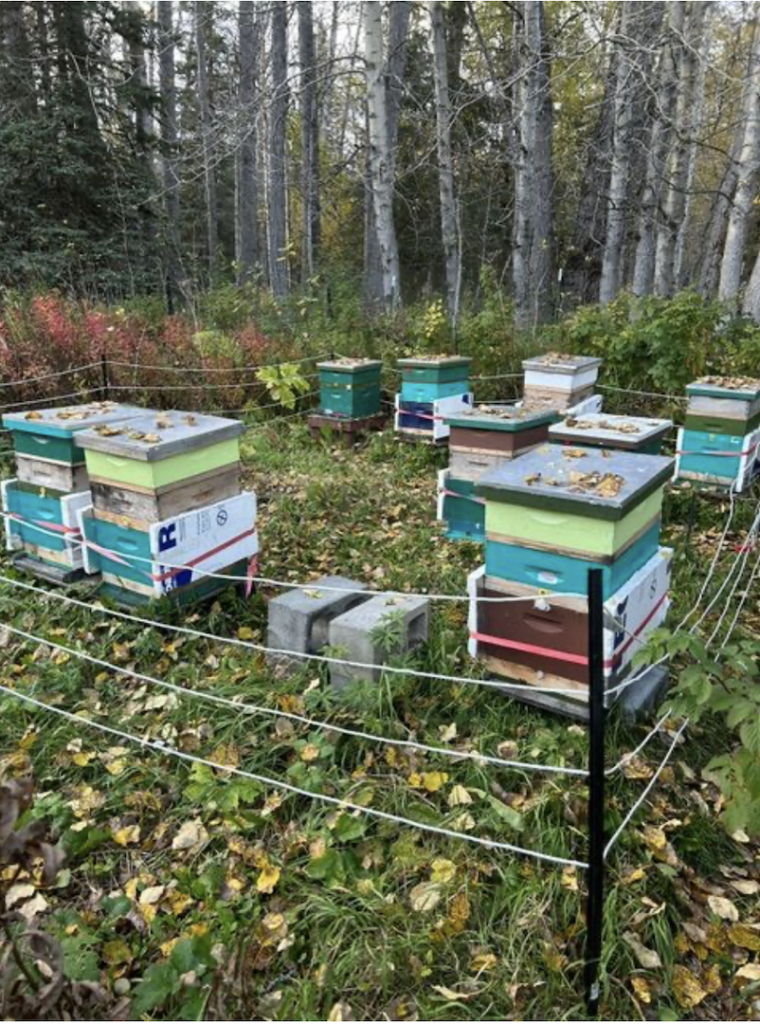
Jeremy Anderson has been keeping bees in Chickaloon for eleven years. It started as a hobby with one hive. There was a demand for more honey. He now has fifteen hives. Each hive has up to ten frames. Each frame contains cells. The bees fill those cells with honey.
Each hive is in a box. It is one colony. A queen bee and her worker bees make up the colony. The worker bees are female. They clean the cells, they guard, they nurse, and they forage for pollen and nectar. They live about six weeks in the summer. They pack a lot of work into their short lives.
The workers are replenished. The queen is constantly producing eggs. She lays fertilized eggs in small cells. They become the female worker bees.
The queen lays unfertilized eggs in bigger cells. These will grow into male drones. The drones sit around and eat until a drone gathering. Dozens of drones wait to mate with a new queen. The drones will mate and die.
Harvesting honey usually begins the first week of August. But not this year. The bees were not happy with the long stretch of cool wet weather. In early July the frames in the hives stood empty. He had to feed sugar water to the bees this summer. Anderson says it was bizarre.
The bees needed the sun to get energized. They soaked it up as July rains tapered off. They felt the pressure of the shorter days. They scoured the fields for flowering plants like fireweed, harebell, yarrow, and cow parsnip. The bees stored an amazing amount of honey in just one month.
The queen and remaining females prepare to overwinter as summer wanes. They face three challenges: staying fed, staying warm, and fresh air.
Their honey is gone by fall. It is on pantry shelves in glass jars. Anderson feeds the bees. He pours sugar water into plastic troughs in each hive. He refills the troughs until the cold arrives in October.
Each hive gets fifty to sixty pounds of sugar. The bees will evaporate the sugar syrup. The bees have to store the sugar in a short period of time. This is their only energy source through the winter. Anderson cannot feed them additional sugar water in the winter. This is a challenge in Alaska.
The bees retreat into their hives. Anderson puts the boxes in a shed to protect them from winter winds. The colony forms a vibrating sphere inside the hive. The bees can raise the temperature to ninety-five degrees in the middle of the ball by flexing their wing muscles. Bees take turns being on the outside.
Moisture is the biggest problem in the hive. The bees create carbon dioxide and water as they eat the stored sugar syrup. This creates a humid environment.
When the moisture hits a cold surface, it freezes. The ice can block air intakes. Each bee keeper has their own way to deal with this issue.
The life of the bees from October to April is simple. They eat sugar, flex wing muscles, and rotate from the center to the outside of a big warm ball of fellow bees.
It takes a strong colony to make it through the winter. There should be enough individuals for the vibrating ball of bees to span all ten frames in the hive.
The queen begins laying eggs again by March or April. Anderson brings the boxes out of the shed in April. Worker bees head out to find the white flowers on willow trees, and the yellow dandelion flowers.
Those days are in the future. Today the bees are winding down. Honey is being harvested. Winter is coming.
Anderson will harvest his honey soon. If you would like to try some, he can be reached at (907) 707-6361.
Page 2 airs weekdays at 7 a.m., 9 a.m., 11:50 a.m., and 6 p.m.
Tune in at 89.7 in Palmer, 89.5 in Sutton, 88.3 in Chickaloon and Glacier View or online at bigcabbageradio.org.
Please support Page 2 News and Big Cabbage Radio. Become a member: Donate today at bigcabbageradio.org.
Kendra Zamzow reported this Page Two article and yours truly, Lee Henrikson produced it. If you have an idea for a Page 2 topic, please email us at page2@radiofreepalmer.org.
That’s it for today and the news on Page Two on Tuesday September 22, 2026.
Photo: Jeremy’s apiary by Jeremy Anderson.