
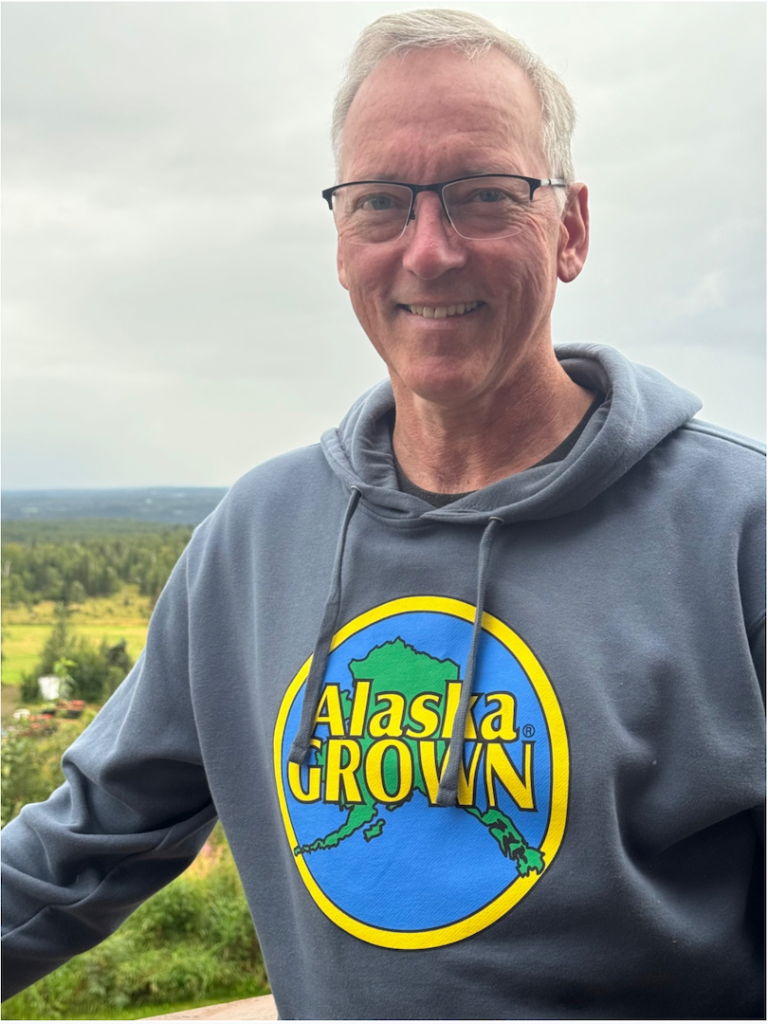
The Alaska Grown logo began as a sketch with a No. 2 pencil about 30 years ago. Doug Warner drew it at his desk in a small back office at the Alaska Division of Agriculture. The logo is now on sweatshirts at farm stands and on grocery store shelves all over Alaska.
Warner started with the Division of Agriculture in 1985. He was the market development specialist. One of his projects was to design a logo to make the quality of Alaskan agricultural products more visible.
So, Warner scratched a logo out at his desk.
He can’t remember if he even used a compass to draw the circle. It might have been a tin can.
Alaska Grown became official in 1986. It is the second-oldest agricultural branding program in the country. Jersey Fresh in New Jersey beat it by a year.
The name was deliberate. Warner wanted something about growing things, not making things. The color choices were intentional. The green state of Alaska stretches across a blue circle framed with a yellow border. Green is for growing. Blue and yellow are for the state flag.
Warner credits his boss Ed Kern for the vision. Kern helped shape the regulations. He gave Warner the room to develop the logo. Several other people in the division also worked on the idea. Warner says, “It wasn’t just me.”
But Warner scratched it out, and in his words ‘gave it legs’.
Warner’s goal was simple. He wanted a logo that let shoppers instantly recognize Alaska products. Quality standards stood behind the mark. It meant something beyond geography.
About five competing designs went before the 300 or so producers at the Alaska Agriculture Symposium in Fairbanks. Warner’s design won. It is now ubiquitous across the state.
A graphic artist converted his sketch into printable process colors so it could be duplicated at scale.
Retailers like Carrs, Safeway, and Fred Meyer resisted the Alaska Grown products at first. They were reluctant to dedicate the shelf space. Customer demand changed that.
The logo took off and developed an identity. T-shirts appeared with slogans identifying born-and-raised Alaskans as distinct from transplants.
Alaska’s balladeer Hobo Jim wrote a jingle for the program. He donated all the proceeds from the jingle to promote Alaska agriculture. The jingle can be found on the Division of Agriculture website.
The logo was blossoming until 2004. It became more about copyright than local produce.
The Mat-Su Farm Bureau chapter was selling Alaska Grown merchandise. The chapter pushed for exclusive rights to the logo when sales became very profitable. The dispute stretched into a four-year legal battle.
Warner remembers that time as costly and divisive among people who should have been on the same side. The case ended when the chapter’s insurer declined to continue backing the legal costs.
The State of Alaska retains the rights to the Alaska Grown logo. People can apply to use the logo through the Division of Agriculture website.
Warner is retired from the division. He and his wife Jill farm hay on their Lazy Mountain homestead.
Many of the old farmers are aging out, he says. He hopes that farmers markets and the Alaska Farmland Trust open doors for new young farmers.
He may not have to look too far. His grandson Rory was asked what adventure sport he preferred: kayaking, skiing or biking. Rory said that he liked growing raspberries best.
Through it all, Warner remains surprised.
“I had no clue the logo would be that popular,” he laughed.
Page 2 airs weekdays at 7 a.m., 9 a.m., 11:50 a.m., and 6 p.m.
Tune in at 89.7 in Palmer, 89.5 in Sutton, 88.3 in Chickaloon and Glacier View or online at bigcabbageradio.org.
Please support Page 2 News and Big Cabbage Radio. Become a member: Donate today at bigcabbageradio.org.
Hobo Jim singing the Alaska Grown Jingle
Emily Forstner reported this Page Two article and yours truly, Lee Henrikson produced it. If you have an idea for a Page 2 topic, please email us at page2@radiofreepalmer.org.
That’s it for today and the news on Page Two on Friday, August 28, 2026.
Photo: Doug Warner at his farm on Lazy Mountain by Emily Forstner