
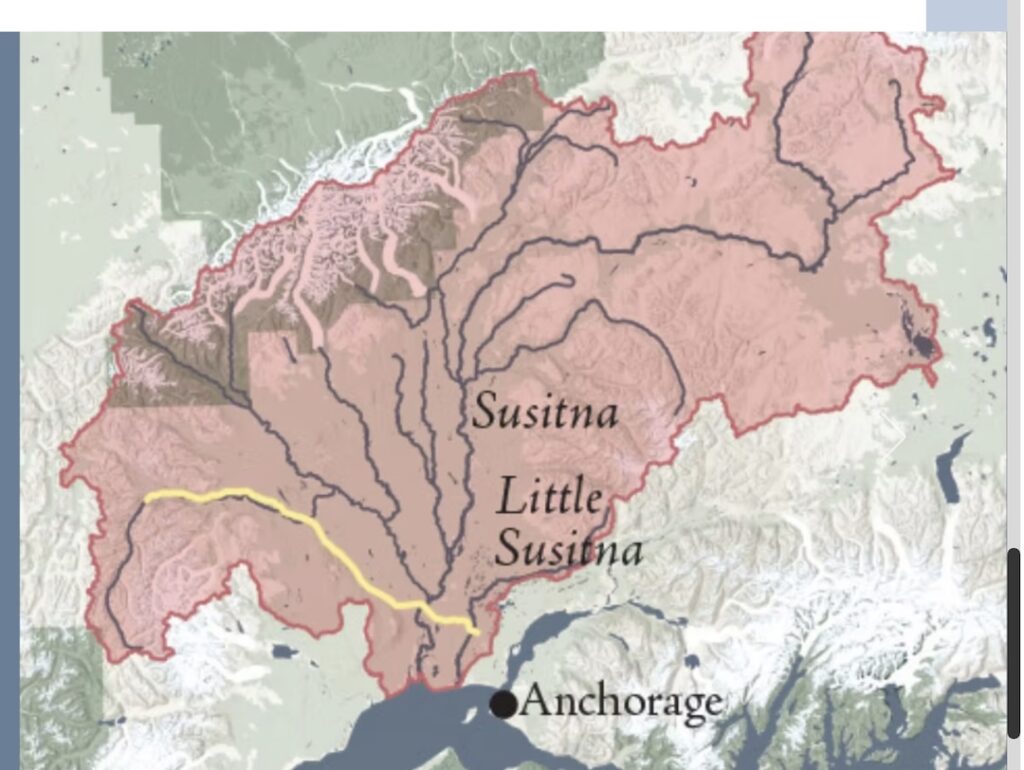
The Susitna River Coalition is kicking off a watershed planning process for the Susitna River basin. Program and Communications Director Margaret Stern said, “This is a community-driven roadmap of what you are seeing, how you are recreating, what you want to protect.”
The watershed contains all the water that flows into the Susitna River. It includes the Chulitna, the Skwentna, and other major rivers, as well as all their tributaries and wetlands. It includes streams like Wasilla Creek and Cottonwood Creek that run through urban areas. Six rivers designated by the state as Recreational Rivers are also in the watershed. These are the Little Susitna, the Deshka, the Talachulitna, and the Talkeetna Rivers, along with Lake and Alexander Creeks.
Information exists about some places, like around Talkeetna. The research that was done for the Su-Watana hydroelectric dam project is valuable, however the Susitna River drainage is huge. It’s over 20,000 square miles of lands that go from bogs to glaciers.
People that use the area have knowledge and a lot to contribute to the watershed plan. One way to contribute is through the survey. What changes have they seen? What are they concerned about? What are they excited about? Maybe they see a bird at a certain place or a certain time, or a fish where they haven’t seen one before. All that information is valuable.
A Citizen Science component begins this month. People who are out on the land can participate and collect new information.
Stern says, “If you are hunting, floating, going on a hike and you come across a body of water you can tell us what is there, what you are seeing because so much of the area hasn’t been characterized. You don’t need to be a scientist. This can be anyone who is just out enjoying the region and wants to provide some of that baseline data. Someone who’s out rafting and wants to collect a little something to benefit the broader picture.”
Citizen Scientists will be provided with kits that contain temperature gauges, fish identification guides, and habitat assessment forms. The kits are small and can be taken along when people go out on the water to work or recreate. People aren’t assigned locations. Part of the process is finding out where people go and what areas are being used.
Citizen Scientists will be asked to log the coordinates at a site, collect water temperature, take photos, and write down what they see about the water, the vegetation, the fish and wildlife. The program goes through September and starts again in the spring.
There are also scheduled field days at core locations. These are opportunities for people to learn how to collect the information, see how it is relevant, and even do some minnow trapping.
Learn more about the Watershed Planning process at susitnarivercoalition.org/watershedplan or contact Margaret Stern at info@susitnarivercoalition.org.
Page 2 airs weekdays at 7 a.m., 9 a.m., 11:50 a.m., and 6 p.m.
Tune in at 89.7 in Palmer, 89.5 in Sutton, 88.3 in Chickaloon and Glacier View or online at bigcabbageradio.org.
Please support Page 2 News and Big Cabbage Radio. Become a member: Donate today at bigcabbageradio.org.
This Page Two article was reported by Kendra Zamzow and produced by yours truly, Lee Henrikson. If you have an idea for a Page 2 topic, please email us at page2@radiofreepalmer.org.
That’s it for today and the news on Page Two on Tuesday June 30, 2026.
Image credit: susitnarivercoalition.org.